
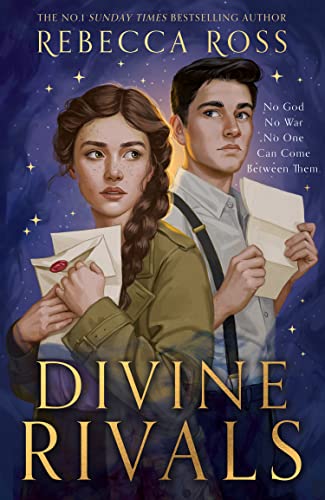
Books Like Divine Rivals
Letters of Enchantment · #1 ›by Rebecca Ross
⚠️ Content Warnings: graphic-violence, war, psychological-trauma
Why people love this book
Divine Rivals works because Ross builds the romance at two speeds simultaneously: Iris and Roman hate each other in the newsroom with the specific contempt of people who recognize each other's talent, and fall in love through letters to a soldier neither of them knows is the other. The epistolary structure gives the book its heart — the letters are where both characters say what they can't afford to say face to face, and Ross writes them with the kind of yearning that makes you grieve on the characters' behalf for what they don't yet know. The mythology is WWI-inspired but god-touched: two divine siblings have gone to war, and ordinary humans are dying in the crossfire, and the newspaper that Iris and Roman work for is the only thing telling the public the truth. The darkness is present but handled with restraint — this is a book more interested in longing than in grief, though it knows both intimately. The slow burn is genuinely agonising in the best possible way.
What you're really looking for?
If you loved Divine Rivals for its epistolary slow burn between rivals who fall in love without knowing it, its WWI-inspired mythology, and its ache of a love story conducted across impossible distances, start with Daughter of the Moon Goddess, Babel, and The Song of Achilles.
If you loved the epistolary romance — the letters that say more than the characters ever would out loud, the slow horror of falling in love with someone without knowing who they are...

The Invisible Life of Addie LaRue
by V.E. Schwab
The closest match for the specific longing in Divine Rivals — a love built entirely from the gap between what is said and what is felt, between presence and absence, between being seen and being forgotten. Addie LaRue has been cursed to be forgotten by everyone she meets the moment they part; Henry is the first person to remember her. Schwab builds the romance from the same emotional materials Ross uses: the ache of connection that shouldn't be possible, the horror of loving someone across an impossible distance. The structure is non-linear and more literary than Ross; the tone is melancholy where Divine Rivals is yearning. But for readers who found the letters the emotional core of the book, Schwab delivers the same quality of longing.
⚠️ Content Warnings: sexual-content, psychological-trauma

The war-setting and mythology comparison: Babel is set in 1830s Oxford, at a translation institute that powers the British Empire through silver-worked magic, and it asks the same question Divine Rivals asks — what do ordinary people owe to truth when the institutions around them are built on lies? The journalism of Divine Rivals and the translation work of Babel are both framed as the act of making the world legible to people who would rather not look. Kuang is considerably darker and more explicitly political than Ross; the romance is secondary to the political tragedy. But readers who loved the intellectual intimacy between Iris and Roman, and the sense of two smart people recognizing each other, will find exactly that in Babel.
⚠️ Content Warnings: graphic-violence, war, child-death
If you loved the mythology — gods at war, their conflict bleeding into the mortal world, ordinary people caught in a divine dispute they didn't choose...

Daughter of the Moon Goddess · The Celestial Kingdom #1
by Sue Lynn Tan
The closest mythological parallel: a world where divine beings have gone to war and the people who love them are destroyed by the fallout, a female protagonist moving through a celestial world that is breathtakingly beautiful and catastrophically dangerous, and a romance built on the specific tenderness of people who have found each other in the middle of something that wants to keep them apart. Tan's prose has the same lyrical patience as Ross's letters; the emotional register is quieter and more Chinese-mythology inflected. But for Divine Rivals readers who loved the sense of the divine pressing down on the human, and the beauty of the world alongside its cruelty, Tan is the natural next read.

The war-mythology romance that Divine Rivals readers most often reach for next. Miller's retelling of the Iliad puts the love story at the centre of an epic that was always about love — Patroclus and Achilles against the backdrop of a divine war that will kill them both. The slow burn is different in structure from Divine Rivals (these characters know each other immediately and fully) but the emotional weight is identical: a love that exists in the shadow of something larger and more powerful than either person, and which is made more unbearable by that shadow. Miller is more classically literary and considerably darker than Ross; the ending is known from the first page.
⚠️ Content Warnings: graphic-violence, war, sexual-content
If you loved Iris and Roman's rivalry — two people who are most themselves when they're competing, who are drawn to each other by the same force that makes them want to win...

A Deadly Education · The Scholomance #1
by Naomi Novik
El and Orion Lake share the same rivals-to-lovers DNA as Iris and Roman: two students at the world's most dangerous magic school who irritate each other because they're the same kind of stubborn, specific, and quietly extraordinary. Novik writes competence-as-attraction the same way Ross does — the reader understands why these two people keep ending up in each other's orbit long before they do. The school setting and dark magic are very different from Divine Rivals' WWI journalism; the tone is drier and funnier. But the slow burn and the rivals dynamic are built the same way.
⚠️ Content Warnings: graphic-violence, psychological-trauma

Serpent & Dove · Serpent & Dove #1
The forced-proximity rivals dynamic pushed further: Lou is a witch hiding from the church that wants to burn her; Reid is the witch hunter she's forced to marry. Mahurin builds the same tension Ross does — two people who should be enemies discovering that they recognize each other in spite of everything — and writes it with the same attention to the specific quality of attraction between people who are arguing. The heat level is higher than Divine Rivals; the tone is more adventure-forward. But the rivals-to-lovers arc and the banter-as-intimacy are directly comparable.
⚠️ Content Warnings: sexual-content, abuse, torture, psychological-trauma
Other readers also searched for